The Balanced Approach to Bullying Prevention
Empowering Student Bystanders with Effective, Safe Intervention Strategies
Overcoming Fear: Why Students Hesitate to Speak Up
We at Reportbullying.com educate students to speak up to an adult if they witness bullying. For most students this can be very terrifying, wondering if they may become the next target or will their peers shun them after they hear they spoke up? With that being said I think most students feel this way because fear is our #1 instinct.
Teachers know to keep reports confidential and they’re always asking students to speak up if they witness bullying. Schools use posters, assemblies, monthly exercises, and with all that some students still don’t speak up! So what other options do we have as bystanders to help reduce bullying without having to speak up?
Understanding Student Fears About Reporting
The reluctance of students to report bullying stems from very real concerns. Despite assurances of confidentiality, students worry about social consequences, potential retaliation, being labeled a “snitch,” and disrupting peer relationships. These fears are particularly acute during middle and high school years when peer acceptance feels critical to social survival.
Research consistently shows that while younger students (grades K-5) are more likely to report bullying to adults, this willingness drops significantly as students enter middle school and beyond. Statistics show that students from K-5 are more likely to speak up to an adult than 6-12 grades. This decline isn’t because older students care less about bullying—it’s because the social stakes feel higher and the fear of consequences intensifies.
Understanding this developmental shift is crucial for educators and parents. We cannot simply insist that students “just report it” without acknowledging their legitimate fears and providing alternative strategies that feel safer and more manageable.
The Balanced Approach: A Powerful Alternative Strategy
There is a balanced approach. The balanced approach is used when someone is talking behind someone’s back and trying to degrade that particular student.
The Balanced Approach represents a paradigm shift in how we empower student bystanders. Rather than requiring formal reporting—which can feel daunting and risky—this strategy gives students a way to intervene in the moment, subtly but effectively disrupting the bullying behavior before it escalates.
How the Balanced Approach Works
Example Scenario: You have two girls together and one girl turns to the other and says “Joanne is such a loser, she couldn’t do anything right.”
The Balanced Response: We can see that this comment is negative so to balance it off we say something positive. “I’m surprised you said that because she is the captain of our volleyball team and she gets in the 90s in all her subjects in class.”
By using the balanced approach you can defuse a negative comment which could have easily turned into gossip and started to ruin this girl’s reputation. By adding the opposite you basically are telling your friend that it’s not nice to say lies about someone.
Why the Balanced Approach is Effective
This technique works on multiple levels. First, it immediately interrupts the negative narrative without creating confrontation. The bystander isn’t accusing their peer of bullying or threatening to report them—they’re simply offering a different perspective.
Second, it provides factual counterpoints that make it harder to continue the negative talk. When someone presents concrete evidence that contradicts the put-down (academic achievement, athletic ability, social contributions), the original speaker is forced to reconsider their statement.
Third, it models empathy and fairness without being preachy. Rather than lecturing about kindness, the balanced approach demonstrates it through action. This peer-to-peer modeling can be far more influential than adult directives.
Finally, it prevents the escalation of gossip and reputation damage. By stopping negative talk early, before it spreads through social networks, the balanced approach protects potential victims from more serious forms of relational bullying.
Additional Benefits of the Balanced Approach
- Low social risk – Students don’t have to formally report or confront, reducing fear of retaliation
- Immediate impact – Works in real-time to stop bullying before it escalates
- Builds positive culture – Gradually shifts peer norms toward kindness and fairness
- Empowers bystanders – Gives students agency without requiring adult intervention
- Teaches critical thinking – Encourages students to question negative narratives
- Develops communication skills – Practices assertiveness in a safe context
- Protects relationships – Allows students to challenge friends without destroying friendships
Five Different Options to Reduce Bullying
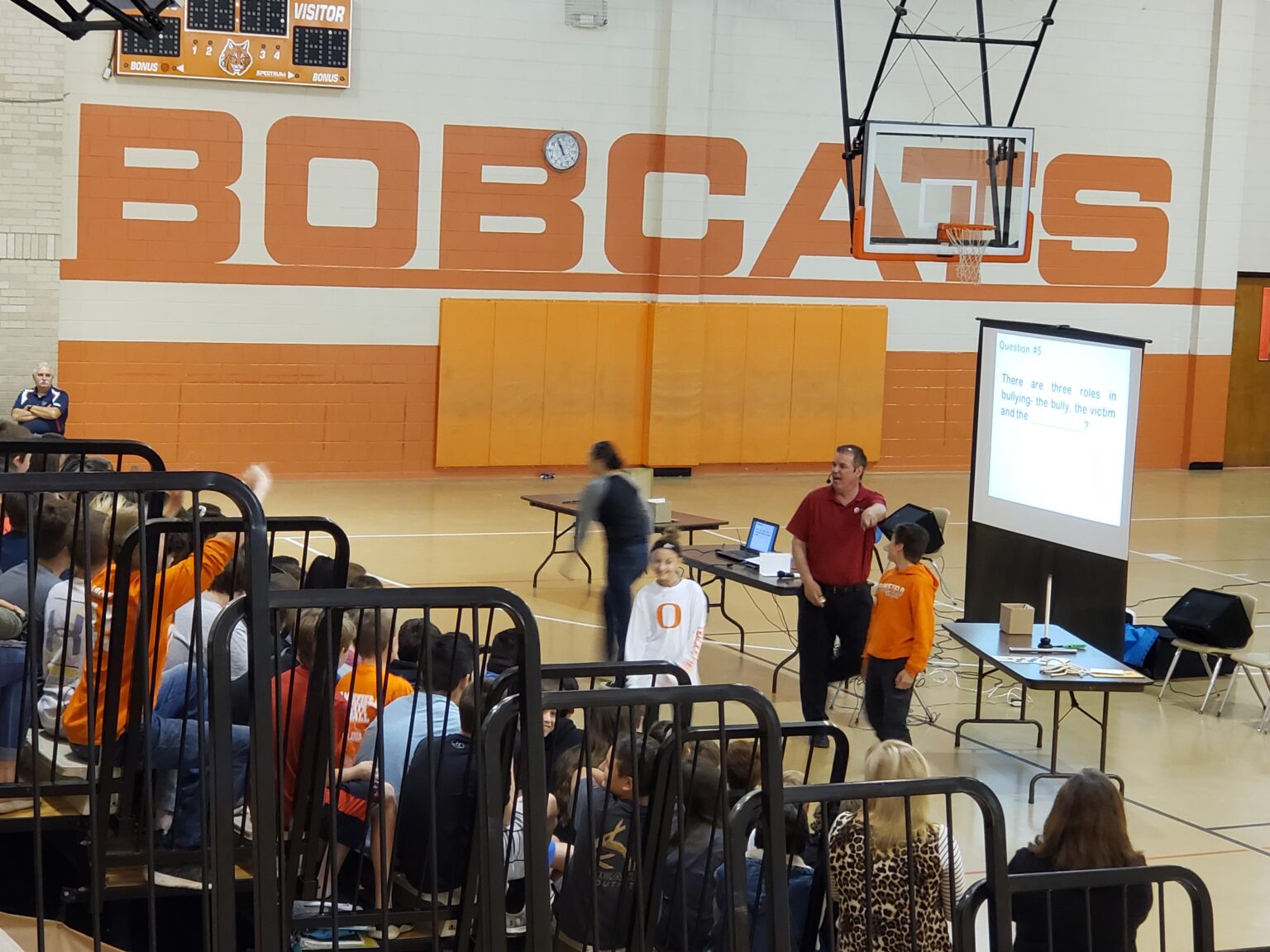
We offer assemblies for all grade levels but only teach the 5 different options to reduce bullying to middle and high school students. Grades K-5 are taught to speak up to an adult. Our assemblies are educational, interactive, and fun.
Age-Appropriate Intervention Strategies
The differentiation between elementary and secondary strategies reflects developmental understanding of how students process social situations at different ages. Younger children benefit from clear, simple directives—tell a trusted adult. Their cognitive development and social structures support this direct approach.
Middle and high school students, however, require a more nuanced toolkit. They’re developing abstract thinking, navigating complex social hierarchies, and testing independence from adult authority. Providing them with multiple intervention options respects their developmental stage while empowering them to make situation-appropriate choices.
The Five Options Framework
While the Balanced Approach is one powerful strategy, comprehensive bullying prevention requires multiple tools. Students need options because every bullying situation is different—what works in one context may not work in another. The five-option framework provides flexibility while ensuring students always have a constructive response available.
These options typically include strategies like the Balanced Approach, supporting the victim privately, using humor to deflect, involving trusted peers, and when appropriate, reporting to adults. By teaching multiple approaches, we increase the likelihood that students will intervene in some way rather than remaining passive bystanders.
Making Education Interactive and Engaging
The effectiveness of anti-bullying education depends heavily on delivery. Dry lectures about kindness and respect rarely change behavior. Students need interactive experiences that let them practice these skills, see them modeled, and understand their real-world application.
Our educational assemblies incorporate role-playing scenarios where students practice using the Balanced Approach and other strategies, group discussions that explore the nuances of different situations, student testimonials that make the content relatable, and interactive activities that reinforce key concepts through experience rather than just explanation.
When students actively participate in their learning—when they speak the words, practice the responses, and think through the scenarios—they’re far more likely to remember and apply these strategies when real situations arise.
Building a Comprehensive Prevention Culture
The Balanced Approach and other bystander intervention strategies work best when they’re part of a comprehensive school culture that values kindness, respect, and accountability. This requires ongoing reinforcement through classroom discussions, peer leadership programs, recognition of students who demonstrate positive bystander behavior, and consistent adult modeling of the same principles.
Schools that successfully reduce bullying don’t rely on a single assembly or program. They integrate these concepts throughout their curriculum, celebrate students who intervene positively, provide regular opportunities to practice these skills, and maintain clear expectations that all community members will work to prevent bullying.
Read More: Cyber Bullying – Are Your Kids Safe? by Jim Jordan
Featured Speaker: Jim Jordan
President of ReportBullying.com
Jim Jordan brings 20 years of experience in anti-bullying education and prevention. As a recognized expert in school safety, he has written four comprehensive books on bullying and is acknowledged by principals all across the USA as the best School Anti-Bullying Speaker.
His evidence-based approach combines practical strategies for parents, educators, and students, creating safer school environments and empowering communities to take action against bullying. Jim’s presentations have transformed countless schools and helped thousands of families develop the tools they need to prevent and address bullying effectively.